What Are the Three Types of Astrology? A Clear Breakdown
Ask ten astrology fans what their “sign” is, and you’ll get ten confident answers based on birthdays. Ask those same ten people what system of astrology they’re actually using, and most will just blink at you. That’s not their fault — astrology isn’t one single tradition. It’s actually a handful of very different systems that developed in different parts of the world, using different math, different starting points, and sometimes wildly different conclusions about the same birthday.
If you’ve ever wondered what are the three types of astrology and why your Western horoscope sometimes contradicts what a Vedic astrologer tells you, this is exactly why. Let’s break down the three major branches, what makes each one tick, and why it matters which one you’re actually reading.
What Are the Three Types of Astrology, Exactly?
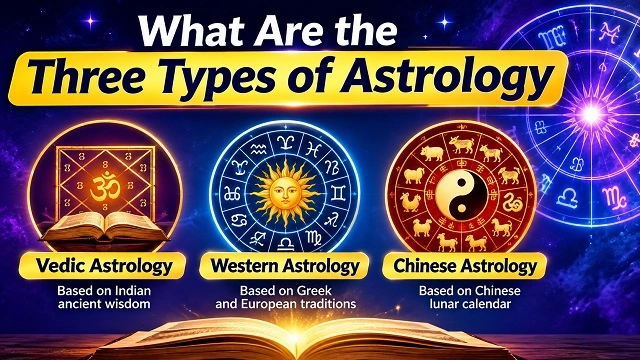
When people ask what are the three types of astrology, they’re usually referring to the three major traditions still widely practiced today:
- Western Astrology — the tropical, Sun-sign-based system most familiar to readers in the US and Europe
- Vedic Astrology (Jyotish) — the sidereal, India-rooted system that calculates planetary positions differently and places heavy emphasis on karma and destiny
- Chinese Astrology — a completely separate system built around a twelve-year animal cycle and five elements, with no direct overlap with the zodiac signs used in the other two
Each of these systems has its own internal logic, its own history, and its own loyal following. None of them is “more correct” than the others in any objective sense — they’re different frameworks built on different assumptions, and each one holds up consistently within its own rules.
Western Astrology: The System Most People Already Know
If you grew up reading horoscopes in a magazine or scrolling past zodiac memes online, you were reading Western astrology without necessarily knowing it. This is the tropical system, meaning it’s based on the seasons rather than the actual physical position of constellations in the sky.
Western astrology divides the sky into twelve equal thirty-degree segments starting from the spring equinox, regardless of where the actual stars happen to sit that year. Your Sun sign, Moon sign, and Rising sign all come from this system, along with the familiar planetary rulerships — Mars ruling Aries, Venus ruling Taurus, and so on.
This is also the system most modern personality-focused astrology comes from, including the popular focus on Big Three placements, synastry for relationship compatibility, and transit-based predictions about timing.
Vedic Astrology: The Sidereal System Rooted in Ancient India
Vedic astrology, also called Jyotish, is one of the oldest systems still actively practiced, with roots going back thousands of years in Indian scripture and tradition. Unlike Western astrology’s tropical, season-based approach, Vedic astrology is sidereal — meaning it’s calculated based on the actual current position of constellations in the sky.
Because the Earth’s axis slowly shifts over centuries (a phenomenon called precession), the tropical and sidereal systems have drifted apart by roughly twenty-three to twenty-four degrees over time. This is the real reason someone can be a Western Leo and a Vedic Cancer at the same time — it’s not a contradiction, it’s two different measuring systems calculating from different starting points.
Vedic astrology also places heavier emphasis on planetary periods called Dashas, which map out specific years of life ruled by specific planets, along with detailed house systems, yogas (specific planetary combinations believed to bring particular life outcomes), and remedies meant to soften difficult placements. It tends to focus more on karma, destiny, and long-term life patterns than Western astrology’s more personality-driven approach.
Chinese Astrology: A Completely Different Framework
Chinese astrology doesn’t use the zodiac wheel at all. Instead, it’s built around a twelve-year cycle, with each year ruled by one of twelve animals — Rat, Ox, Tiger, Rabbit, Dragon, Snake, Horse, Goat, Monkey, Rooster, Dog, and Pig. Rather than being based on your birth month, your animal sign is based on your birth year.
Layered on top of the twelve animals are five elements — Wood, Fire, Earth, Metal, and Water — which cycle through in a sixty-year pattern, meaning your exact combination of animal and element only repeats once every sixty years. This is why a “Fire Dragon” and a “Wood Dragon” are considered meaningfully different, even though they share the same animal.
Chinese astrology also incorporates concepts like Yin and Yang balance and the interaction between elements (some elements strengthen each other, some create conflict), which shapes how compatibility and personality are read within this system.
Why the Three Types of Astrology Give Different Answers
If you’ve ever compared a Western horoscope to a Vedic reading and felt confused by how different they sounded, that’s completely expected once you understand what are the three types of astrology and how differently each one calculates. Western astrology uses the tropical zodiac and focuses heavily on psychological interpretation. Vedic astrology uses the sidereal zodiac and focuses more on destiny, karma, and precise predictive timing. Chinese astrology skips the zodiac altogether and works from an entirely separate cyclical framework based on birth year.
None of these systems are trying to answer the exact same question. Western astrology tends to ask “who are you and how do you tend to behave.” Vedic astrology tends to ask “what is your life path and when will key events unfold.” Chinese astrology tends to ask “what larger cyclical pattern were you born into, and how does that shape your temperament.”
Which System Should You Actually Use?
There’s no universally “correct” answer here, and most serious astrology practitioners will tell you the same thing: it depends on what you’re trying to understand.
- If you want quick personality insight and relationship compatibility reading, Western astrology is the most accessible starting point, with the widest range of free tools and calculators available.
- If you’re interested in deeper predictive timing, karmic patterns, or long-term life direction, Vedic astrology offers a more detailed, structured framework, though it usually requires more precise birth data and often benefits from a knowledgeable practitioner.
- If you’re curious about broader generational or cyclical personality patterns, Chinese astrology offers a completely different, culturally rich lens that doesn’t require exact birth time, just birth year (and ideally month, for more nuanced readings).
Plenty of people actually use more than one system, treating each as a different angle on the same underlying question rather than picking one and dismissing the rest.
A Quick Comparison
| Western | Vedic | Chinese | |
|---|---|---|---|
| Zodiac type | Tropical (seasons) | Sidereal (actual star positions) | No zodiac wheel — animal/year cycle |
| Main focus | Personality, psychology | Karma, destiny, timing | Cyclical temperament, generational traits |
| Key tool | Sun/Moon/Rising signs | Dashas, yogas, houses | Animal sign + element |
| Cycle length | 12 signs, repeats yearly | 12 signs, repeats yearly (shifted) | 60-year full cycle (animal + element) |
Common Misunderstandings Worth Clearing Up
A few mix-ups come up constantly once people start exploring beyond their first astrology system:
- “Vedic astrology is just Western astrology with different names.” Not quite — the sidereal calculation genuinely shifts sign placements, not just terminology.
- “Chinese astrology is a simplified version of the zodiac.” It’s not a simplified version of anything else — it’s an entirely separate system with its own history and internal logic, layered with the five-element cycle.
- “One system is scientifically ‘more accurate’ than the others.” All three are interpretive frameworks rather than empirically validated systems in the scientific sense, so accuracy debates tend to miss the point of what each tradition is actually trying to do.
Final Thoughts
Understanding what are the three types of astrology isn’t just trivia — it explains why two astrology readings about the exact same birthday can sound completely different, and it helps you pick the right tool for whatever question you’re actually trying to answer. Western astrology gives you personality and relationship insight. Vedic astrology gives you structured, destiny-focused timing. Chinese astrology gives you a broader cyclical lens based on the year you were born. None of them cancel each other out — they’re just different maps of the same sky, drawn from different starting points centuries apart.
Frequently Asked Questions
Can I have different signs in Western and Vedic astrology? Yes, and it’s actually common. Because Vedic astrology uses the sidereal zodiac and Western astrology uses the tropical zodiac, the same birthday can fall into a different sign depending on which system you’re using.
Is Chinese astrology based on birth month or birth year? Primarily birth year, since each year is ruled by one of twelve animals. Some more detailed Chinese astrology systems also factor in birth month and hour for a fuller reading, but the animal sign itself comes from the year.
Which type of astrology is the oldest? Vedic astrology is often considered one of the oldest continuously practiced systems, with roots tracing back thousands of years, though Chinese astrology also has an extremely long, separately developed history.
Do I have to pick just one system to follow? Not at all. Many people use Western astrology for personality and relationship insight while also exploring Vedic or Chinese astrology for different kinds of questions, since each system offers a different lens rather than competing answers.
This article is intended for entertainment and educational purposes only and is not a substitute for professional guidance of any kind.