Do Identical Twins Have the Same Numerology Number?
My cousin is an identical twin, and every family gathering someone brings up how she and her sister are basically “the same person,” right up until you actually talk to them for five minutes and realize they’re not, not even close. One’s blunt and impatient, the other’s the family diplomat who smooths over every argument before it starts. Same face, same birthday, same DNA close enough to be indistinguishable under most tests. Wildly different people.
Which made me genuinely curious what numerology, a system built entirely around birthdates and names, actually has to say about twins specifically, since on paper they seem like it should break the whole thing.
Short answer: it’s more complicated than a simple yes or no, and the details are actually pretty interesting once you dig in.
The Life Path Number Situation
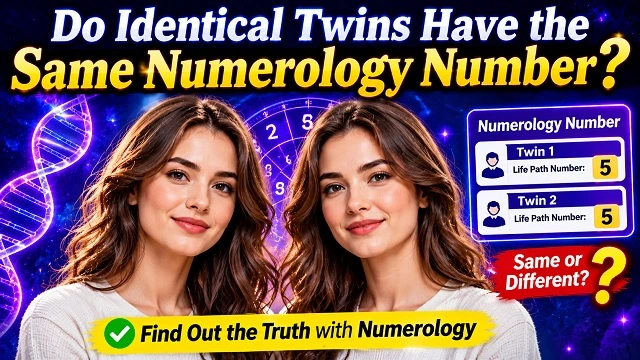
Here’s where it gets almost too simple. Since a Life Path Number is calculated purely from date of birth, and identical twins share the exact same birth date in the vast majority of cases, they will have the exact same Life Path Number. No calculation trick changes this. If one twin is a Life Path 7, so is the other, every single time, assuming they were born on the same calendar day, which the overwhelming majority of twins are.
This alone tends to surprise people who assume numerology must somehow account for individual uniqueness the way a fingerprint does. It doesn’t, at least not at the Life Path level. Two completely unrelated strangers born on the same date share a Life Path Number too. Numerology was never designed to produce a unique number per person, only a shared category, similar in spirit to how millions of people share the same zodiac sign.
Where It Gets More Interesting: Names
This is the part that actually differentiates twins numerologically, and it’s worth understanding properly. Your Expression Number, Soul Urge Number, and Personality Number are all calculated from your full name, not your birth date. Since twins virtually always have different names, even when those names sound similar or were deliberately chosen to rhyme or match (think Jayden and Kayden, or Emma and Ella), the actual letters, and therefore the actual numerology, can end up meaningfully different.
Even twins given genuinely similar-sounding names often land on different Expression Numbers, since numerology calculates letter by letter, and small differences add up. My cousin and her twin have names that share three letters and diverge on the rest, and their Expression Numbers come out completely different as a result. According to the traditional framework, this is actually where their real individual differences would supposedly show up, not in the shared Life Path, but in the name-based numbers that reflect their distinct identities.
What About the Rare Cases Where Twins Are Born on Different Days?
Worth mentioning because it genuinely happens, and it’s a fun edge case for anyone thinking hard about this. Twins born close to midnight can sometimes end up with different birth dates, one arriving just before midnight, the other just after. In these specific, relatively rare cases, the twins would actually have different Life Path Numbers too, despite being twins in every biological sense.
It’s a small reminder that numerology is following the calendar literally, not the biological reality of twin birth, which technically happens as one continuous event regardless of which side of midnight each birth certificate lands on.
What About Personal Year Numbers?
Worth a quick mention since it’s a natural follow-up question once you’ve worked through Life Path and name-based numbers. Personal Year Numbers, which shift annually based on birth month, day, and the current calendar year, would also match between twins for the same reason Life Path does, since twins share both birth month and day in the vast majority of cases.
So year to year, twins would traditionally be read as moving through the same broad numerology “theme” simultaneously, even as their name-based numbers continue pointing toward different individual traits. It’s a small but interesting detail if you’re trying to map out exactly where twins’ numerology overlaps and where it splits.
Does This Mean Numerology Fails the “Twin Test”?
Here’s an honest, slightly skeptical take worth sitting with. If you’re looking for numerology to explain why two people who share a birthday, and in the case of identical twins, share nearly identical genetics, end up with such different personalities, the system doesn’t really deliver a satisfying mechanism. The name-based numbers technically differ, sure, but that difference exists purely because parents happened to choose different names, not because of anything inherent about the individual.
If my cousin’s parents had somehow given both twins the exact same name, which obviously doesn’t happen in practice but is a useful thought experiment, their numerology profiles would be genuinely identical across the board, despite being two distinct people with distinct personalities in real life.
This is actually a pretty clean illustration of a broader point worth keeping in mind whenever you’re using numerology for self-reflection. The system describes broad, shared categories, not individual uniqueness. Twins sharing a Life Path Number isn’t a flaw or a loophole, it’s just numerology working exactly as designed, which was never really built to capture what makes any specific person, twin or not, distinctly themselves.
So What Actually Explains Twin Personality Differences?
Not numerology’s department, honestly, and worth saying plainly rather than dancing around it. Developmental psychology has looked at this question far more rigorously than any symbolic system could, and the research points toward a mix of factors: differing experiences in the womb, birth order even by minutes, subtly different treatment from parents and other people despite looking identical, and each twin actively working to differentiate themselves from someone they’re constantly compared to. None of that shows up in a numerology chart, which only has access to a date and a name.
How to Actually Use This If You’re a Twin, or Know One
If you’re a twin curious about your own numerology, the more genuinely interesting numbers to compare with your sibling are the name-based ones, Expression, Soul Urge, and Personality, since those actually differ and might feel more reflective of your individual differences than the shared Life Path Number ever could. Treat the shared Life Path less as “proof you’re the same” and more as confirmation of something numerology already assumes broadly, that a huge number of unrelated people share every possible number, twins or not.
And if your name numbers land closer together than you expected, that’s worth noting too, not as evidence numerology is broken, but as a reminder that even meaningfully different names can occasionally reduce to similar totals through simple coincidence, the same way two completely unrelated phone numbers can add up to the same digit sum without meaning anything about the people who own them.
FAQS: Do Identical Twins Have the Same Numerology Number?
Do fraternal twins also share the same Life Path Number?
Usually yes, for the same reason identical twins do — Life Path is calculated purely from birth date, and fraternal twins are typically born on the same calendar day even though they’re genetically no more similar than regular siblings.
Can twins have different Life Path Numbers?
In rare cases, yes, specifically when one twin is born just before midnight and the other just after, landing on two different calendar dates.
Which numerology number actually differs most between twins?
The Expression, Soul Urge, and Personality numbers, since these are calculated from full names rather than birth dates, and twins virtually always have different names.
Does sharing a Life Path Number mean twins have identical personalities?
No. Millions of unrelated people share the same Life Path Number, and personality is shaped by far more than a single numerology category, twin or not.
This article is intended for general informational and entertainment purposes. Numerology is a traditional belief system, not an empirically validated science, and shouldn’t be used to explain or predict real personality differences between individuals, including twins.