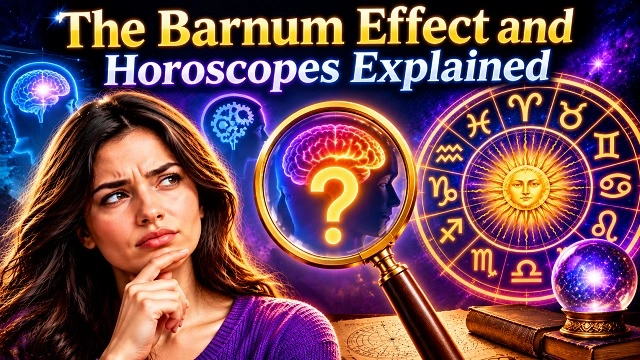
The Barnum Effect and Horoscopes Explained
Years ago I read two horoscopes for the same day, one for my actual sign and one for a sign that wasn’t mine at all, just to see what would happen. Both felt weirdly accurate. Both described me pretty well. That’s when I actually looked into why, and it turns out there’s a name for exactly what I’d stumbled into, and understanding it changed how I read horoscope content for good.
That name is the Barnum effect, sometimes called the Forer effect, and once you understand it, you genuinely can’t unsee it in astrology content, personality quizzes, or basically any of the vague self-description stuff that fills the internet.
What the Barnum Effect and Horoscopes Actually Have in Common
The Barnum effect describes a well-documented psychological phenomenon where people rate vague, general personality descriptions as highly accurate specifically to themselves, even when the exact same description is being handed out to everyone. It’s named after P.T. Barnum, the showman famous for the phrase “a sucker born every minute,” and it was first demonstrated scientifically by psychologist Bertram Forer back in 1948, which is why you’ll also see it called the Forer effect depending on which source you’re reading.
Forer’s original experiment is worth knowing because it’s genuinely simple and genuinely convincing. He gave his psychology students a personality test, told them he was analyzing their individual results, then handed everyone the exact same generic description, regardless of how they’d actually answered. Things like “you have a tendency to be critical of yourself” and “you pride yourself on being an independent thinker.” Students rated the accuracy of their supposedly personalized results at over 4 out of 5 on average. Every single student got the identical paragraph.
Why the Barnum Effect and Horoscopes Are Basically Made for Each Other
Horoscope writing, whether it’s a daily newspaper column or a longer astrology profile, tends to lean heavily on statements broad enough to feel true for almost anyone while still sounding specific. “You’ve been putting on a brave face lately, but deep down you’re craving more connection” sounds tailored to you personally, right up until you realize it applies to a genuinely huge chunk of adults on any given week, sign completely irrelevant. That’s not necessarily astrology writers being deliberately dishonest, to be fair.
A lot of this is just how the genre evolved, since vague-but-resonant language is what keeps people reading and coming back, whether or not anyone involved is thinking about it in terms of the Barnum effect specifically.
A few features make a statement especially “Barnum-friendly,” and once you notice them you’ll spot them constantly. Statements that acknowledge two opposite tendencies at once, “you can be reserved, but people who know you well see a much bolder side,” cover basically everyone regardless of which half feels truer on a given day.
Flattering framing helps too, people rate positive-sounding traits as more accurate than neutral or negative ones, so a lot of horoscope language leans generous almost by default. And genuinely universal experiences, self-doubt, wanting to be understood, occasional restlessness, get dressed up as if they’re a specific insight unique to your sign, when they’re really just things nearly everyone relates to sometimes.
Does the Barnum Effect and Horoscopes Mean Astrology Is Completely Fake
Not exactly, and this is where I think a lot of skeptical takes overreach a little. The Barnum effect explains why vague horoscope language feels personally accurate. It doesn’t necessarily prove astrology’s underlying claims are false, those are actually two separate questions that get conflated constantly. It’s entirely possible for the celestial mechanics behind astrology to be unsupported by evidence, which controlled research generally suggests, while the Barnum effect is simultaneously doing a lot of the heavy lifting in why any specific horoscope reading feels convincing in the moment. Both things can be true at once. The psychology explains the experience. It doesn’t settle the deeper metaphysical question on its own.
How to Actually Spot the Barnum Effect and Horoscopes in the Wild
Once you know what to look for, it gets pretty easy to catch. Read a horoscope meant for a different sign than your own sometime and notice how much of it still feels applicable. Pay attention to how often a description hedges both directions, giving you an out no matter which way you actually lean. Notice how rarely horoscope content includes anything genuinely falsifiable, a specific claim that could clearly turn out wrong, versus how often it stays comfortably vague enough that almost any outcome could be read as a fit after the fact.
This isn’t really unique to astrology either, worth saying clearly. Personality tests, cold readings from psychics, even some corporate team-building personality frameworks lean on the exact same psychological mechanism. The Barnum effect is a general feature of how humans process self-relevant information, not a flaw specific to horoscopes. Astrology just happens to be one of the more visible, widely consumed examples of it in everyday life.
Why Astrology Sites Keep Using Barnum-Style Language Anyway
If the Barnum effect and horoscopes are this closely linked, and plenty of writers presumably know it, why does the pattern persist so heavily across the industry? Partly it’s just incentive structure. Vague, flattering, broadly-applicable language keeps more readers engaged and coming back than narrow, falsifiable predictions that could clearly miss. A horoscope that says “avoid all financial risk today” is either obviously right or obviously wrong by tomorrow.
A horoscope that says “trust your instincts around money this week” is functionally unfalsifiable, and reads as wise regardless of what actually happens. That’s not a conspiracy so much as an evolutionary pressure the genre’s been under for decades, long before anyone had a name for the psychology behind it.
So Should You Stop Reading Horoscopes
That’s genuinely up to you, and I don’t think knowing about the Barnum effect has to ruin the experience if you’re enjoying it for what it actually is. Plenty of people read horoscopes purely as a lightweight, reflective ritual, not a literal prediction, and understanding the psychology behind why it feels accurate doesn’t necessarily take that value away. What it does do is give you a more honest relationship with the content. You can enjoy the reflection prompt without mistaking the feeling of accuracy for actual, verified insight into your specific future.
FAQs:
If anything, understanding the Barnum effect makes you a sharper, more discerning reader of this kind of content generally, not just horoscopes specifically. You start noticing vague, universally-applicable language everywhere, not just in astrology, and that’s a genuinely useful skill whether you’re reading a horoscope, a personality quiz, or a vague LinkedIn post claiming to describe exactly what kind of leader you are. Once the Barnum effect and horoscopes click together in your head as a pattern, it’s genuinely hard to read this kind of content the same passive way again, and honestly, that’s probably a good thing.
Is the Barnum effect the same thing as confirmation bias?
Related but distinct. The Barnum effect explains why vague statements feel personally accurate. Confirmation bias explains why, once you believe something, you tend to notice evidence that supports it and overlook evidence that doesn’t. Horoscope reading often involves both working together.
Does the Barnum effect mean I’m gullible if a horoscope feels accurate to me?
No, it’s a well-documented feature of normal human psychology, not a personal flaw. Forer’s original study found this effect across an entire class of psychology students, not just people predisposed to believe things easily.
Can astrology still be meaningful even if the Barnum effect explains part of it?
Yes, for a lot of people. Many use astrology as a reflective tool or shared cultural language rather than a literal predictive system, and that kind of value doesn’t necessarily depend on the descriptions being uniquely accurate to begin with.
How can I tell if a horoscope is more Barnum-style vague or genuinely specific?
Try reading it without knowing which sign it’s written for. If it still feels broadly applicable to almost anyone, that’s a sign it’s leaning on general, universally resonant language rather than anything specifically tied to astrological placement.
This article is intended for general informational and entertainment purposes. Astrology is a traditional belief system, not an empirically validated science, and shouldn’t be used as the sole basis for major life, financial, medical, or legal decisions.