What Is a Karmic Debt Number in Numerology? (13, 14, 16, 19 Explained)
If you’ve been digging into numerology for a while, you’ve probably calculated your Life Path Number, maybe your Expression Number too, and then stumbled across a term that sounds a lot more intense: karmic debt number. It sounds like something out of a spiritual thriller — like you owe the universe something and it’s about to collect. So let’s slow down and actually unpack what this means, where it comes from, and why it’s a lot less scary than it sounds.
The Short Version
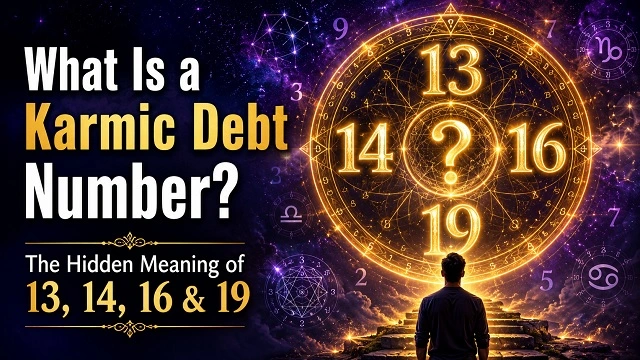
A karmic debt number shows up when one of four specific numbers — 13, 14, 16, or 19 — appears in the middle of a numerology calculation, before you reduce it down to a single digit. Numerologists treat these four numbers differently than other double-digit totals. Instead of just being a step on the way to your final number, they’re read as a flag: a sign that this lifetime is asking you to work through a specific growth theme.
That’s really it. It’s not a curse, it’s not a debt in the financial sense, and it’s definitely not a countdown to something bad happening. It’s more like a heads-up about a pattern worth paying attention to.
Wait, Why Only These Four Numbers?
Good question, and it’s one a lot of numerology explainers skip. Numerology works by reducing numbers down through addition — you take a total, add its digits together, and keep going until you land on a single digit (1 through 9), unless you hit 11, 22, or 33, which get special “master number” treatment and stay as they are.
Along the way, some numbers just happen to be double digits that reduce down normally, like 25 becoming 2+5=7, no drama involved. But four specific numbers — 13, 14, 16, and 19 — got singled out by early 20th-century numerology writers as carrying extra weight. The reasoning traces back partly to numerology’s long-running association with certain numbers as “unlucky” or “heavy” in Western superstition (13 being the obvious one), and partly to older esoteric traditions that assigned symbolic meaning to specific number sequences.
So to be clear: this isn’t an ancient, universally agreed-upon system going back thousands of years. It’s a 20th-century layer added onto numerology, most commonly credited to writers like Florence Campbell, whose 1931 book on numerology helped popularize karmic debt numbers as a distinct concept within Western numerology practice.
Where the Word “Karmic” Actually Comes From
Here’s something worth being upfront about, because it gets glossed over constantly in numerology content: the word “karma” isn’t a numerology invention. It comes from Hindu, Buddhist, and Jain philosophical and religious traditions, where it refers to the ethical weight of a person’s actions — the idea that intentional actions have consequences, often understood across multiple lifetimes depending on the tradition.
What Western numerology did, starting in the early-to-mid 1900s, was borrow that general concept — actions having consequences that carry forward — and apply a simplified version of it to specific numbers. This is worth knowing because “karmic debt numbers” aren’t a teaching from within Hinduism, Buddhism, or Jainism themselves. They’re a Western numerology adaptation that uses the word “karma” more loosely, closer to “an inherited lesson” than the fuller religious and philosophical concept the word originally describes. If you want to understand karma as it’s actually taught within those traditions, numerology isn’t the place to look — that’s a much deeper, more specific body of religious philosophy.
The Three Places a Karmic Debt Number Can Show Up
This part trips people up, because karmic debt numbers aren’t calculated on their own — they surface inside other numerology calculations you might already be familiar with.
1. Your birth day, directly. This is the simplest one. If you were born on the 13th, 14th, 16th, or 19th of any month, that number is considered your karmic debt number outright, no extra math needed.
2. Inside your Life Path Number calculation. Remember how you add up every digit of your birth date and keep reducing until you hit a single digit? If, at any point during that reduction, your running total lands exactly on 13, 14, 16, or 19 before you reduce it further, that’s a karmic debt showing up inside your Life Path.
3. Inside your Expression Number calculation. Same idea, but using the numbers assigned to the letters in your full birth name instead of your birth date. If the sum passes through 13, 14, 16, or 19 before its final reduction, that counts too.
Because of this, it’s completely possible to have zero karmic debt numbers, one, or even more than one across these three checks. There’s no rule that says everyone has to have one.
What Each Number Is Said to Represent
Numerology writers don’t treat all four karmic debt numbers the same way — each one is tied to a different theme. Here’s the general idea behind each, described in growth-oriented terms rather than the more fear-based language you’ll sometimes find in older numerology writing:
13 is traditionally connected to discipline and follow-through. The theme here isn’t laziness as a moral failing — it’s more about learning to turn scattered energy into steady, patient effort, and sticking with things long enough to see them through.
14 is traditionally connected to balance, especially around freedom and change. People associated with this number are sometimes described as needing to learn moderation — enjoying variety and change without letting it spiral into instability.
16 is traditionally connected to humility and honest self-reflection. This one often gets described alongside stories of unexpected upheaval — a sudden shift that forces a person to rebuild on more solid, more honest ground than before.
19 is traditionally connected to the tension between independence and consideration for others. The lesson here is usually framed as learning to be self-reliant without becoming isolated or dismissive of the people around you.
Again — these are symbolic themes within a belief system, not diagnoses or predictions. Two people with the same karmic debt number are going to live completely different lives.
Is Having a Karmic Debt Number a Bad Thing?
No, and this is honestly the most important point in this whole article. A lot of older or more dramatic numerology content frames karmic debt numbers around the idea of “paying for mistakes from a past life,” which understandably makes people anxious when they calculate their number and see one show up.
A more grounded way to think about it, and the framing more modern numerology writers tend to favor, is this: everyone has some kind of growth edge, some area of life that takes more conscious effort than it seems to for other people. Karmic debt numbers are just numerology’s way of naming a specific version of that. They’re not a punishment, and they’re definitely not a life sentence. Plenty of people with karmic debt numbers live happy, successful, totally ordinary lives — the “lesson” is more of a background theme than a foreground plot.
And on the flip side, if you calculate your numbers and don’t find a karmic debt number anywhere, that doesn’t mean you’ve somehow got it easier than everyone else, either. It just means this particular numerology concept doesn’t happen to apply to your specific numbers.
How to Actually Use This Information
If any of this resonates with you, here’s a reasonable way to approach it: treat your karmic debt number, if you have one, as a prompt for reflection rather than a fact about your future. Ask yourself honestly whether the theme described — discipline, balance, humility, or independence — actually shows up as a recurring pattern in your life. If it does, that’s useful self-knowledge, regardless of whether you believe the numerology framework itself is “true” in any scientific sense. If it doesn’t resonate at all, that’s fine too — you’re allowed to take what’s useful from a belief system and leave the rest.
What you shouldn’t do is treat a karmic debt number as an excuse (“well, I have karmic debt 14, so of course I struggle with commitment”) or as a source of ongoing anxiety. Neither of those uses does justice to what’s really just a reflective tool.
Finding Your Own Karmic Debt Numbers
If you’d rather not do the addition and reduction by hand three separate times, a calculator can check your birth day, Life Path calculation, and Expression calculation all at once and tell you clearly whether 13, 14, 16, or 19 shows up anywhere in your numbers — and if none do, it’ll tell you that too, so you’re not left wondering if you did the math wrong.
Frequently Asked Questions
Can I have more than one karmic debt number?
Yes. Since the check happens in three separate places (your birth day, your Life Path calculation, and your Expression calculation), it’s possible for more than one of the four karmic debt numbers to show up for the same person.
Is 13 always unlucky in numerology because of karmic debt?
Not exactly. Karmic debt numbers describe a growth theme, not bad luck in the day-to-day sense most people mean when they call 13 “unlucky.” The cultural superstition around 13 and the numerology concept of karmic debt are related but not identical.
Do karmic debt numbers come from Hindu or Buddhist teachings on karma?
Not directly. The word “karma” comes from those traditions, but “karmic debt numbers” as a specific numerology concept were developed by Western numerology writers in the 20th century, applying a simplified version of the broader idea to particular numbers.
What if my Life Path Number is a master number (11, 22, or 33) — can I still have a karmic debt number?
Yes. The karmic debt check happens on the running total during your calculation, before you reach your final Life Path or Expression number, so it’s possible to pass through a karmic debt number on your way to a master number.
This article is intended for general informational and entertainment purposes. Numerology is a traditional belief system, not an empirically validated science, and shouldn’t be used as the basis for major life, financial, medical, or legal decisions.