How To Calculate Expression Number Numerology (Easy Guide)
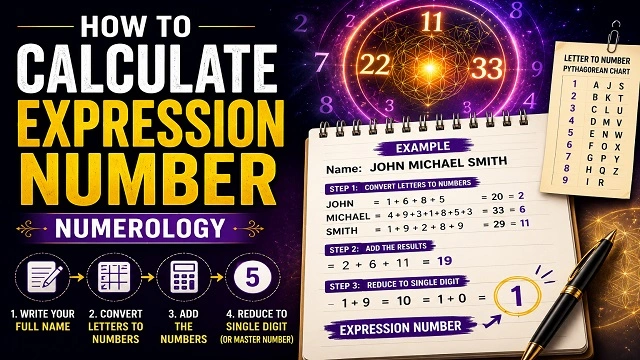
You’ve probably heard of a Life Path Number before — it’s the famous one, calculated from your birthday, that gets all the attention in numerology content. But there’s a second number that numerologists actually consider just as important, and it’s calculated from something completely different: your name. It’s called the Expression Number, sometimes labeled the Destiny Number, and if you’ve never worked it out before, the process is simpler than it looks once you see it laid out step by step.
This guide walks through exactly how to calculate it by hand, with a full worked example, plus what it’s actually supposed to represent once you have it.
What the Expression Number Actually Is
Your Expression Number comes from every single letter in your full birth name — first, middle, and last, exactly as it appeared on your birth certificate. Numerologists treat it as a kind of blueprint for your natural talents and abilities, the skills and traits you were essentially “built with,” separate from anything you learned or developed later in life.
This is different from your Life Path Number in a meaningful way. Your Life Path comes from your birthday and is read as your life’s overall direction and core lessons. Your Expression Number comes from your name and is read more as your innate toolkit — the raw material you’re working with, regardless of which direction your life ends up taking.
Step 1: Assign a Number to Every Letter
Numerology’s most widely used system — the one behind basically every calculator you’ll find online, including any tool on this site — is called the Pythagorean system, named after the ancient Greek mathematician Pythagoras. It assigns each letter of the alphabet a number from 1 to 9, cycling back around once it hits 9. Here’s the full chart:
- 1 = A, J, S
- 2 = B, K, T
- 3 = C, L, U
- 4 = D, M, V
- 5 = E, N, W
- 6 = F, O, X
- 7 = G, P, Y
- 8 = H, Q, Z
- 9 = I, R
Notice the pattern — A is 1, B is 2, and so on up to I at 9, then J starts back over at 1. It repeats in groups of nine all the way through Z.
Step 2: Write Out Your Full Name and Convert Every Letter
Take your full birth name and, letter by letter, write the number that corresponds to each one underneath it. Skip spaces, but keep every letter, including middle names.
Let’s work through an example using the name Sarah Jane Mitchell.
S  A  R  A  H     J  A  N  E     M  I  T  C  H  E  L  L
1  1  9  1  8     1  1  5  5     4  9  2  3  8  5  3  3
Step 3: Add Every Number Together
Now just add up every single number you wrote down, across the entire name, first name through last:
First name (SARAH): 1+1+9+1+8 = 20 Middle name (JANE): 1+1+5+5 = 12 Last name (MITCHELL): 4+9+2+3+8+5+3+3 = 37
Total: 20 + 12 + 37 = 69
Step 4: Reduce the Total to a Single Digit
This is the same reduction process used for a Life Path Number. Take your total and add its digits together, then keep repeating until you land on a single digit — unless you hit 11, 22, or 33 along the way, which numerologists treat as “master numbers” and leave unreduced.
69 → 6 + 9 = 15 15 → 1 + 5 = 6
So Sarah Jane Mitchell’s Expression Number is 6.
A Quick Word on Master Numbers
If your running total ever lands exactly on 11, 22, or 33, most numerology traditions say to stop reducing right there. These three numbers are considered “master numbers,” believed to carry an intensified version of their reduced counterpart (11 relates to 2, 22 relates to 4, and 33 relates to 6), along with extra significance of their own. So if your addition brings you to 22, your Expression Number is 22 — not 4.
What to Do If a Karmic Debt Number Shows Up
Here’s a detail a lot of quick guides skip. While you’re reducing your total step by step, keep an eye out for whether your running total ever lands exactly on 13, 14, 16, or 19 before you reduce further. Numerology treats these four numbers as “karmic debt numbers” — not a bad omen, but a flag for a specific growth theme tied to discipline, balance, humility, or independence, depending on which number shows up. It’s worth noting if one appears during your Expression Number calculation, even though you’ll keep reducing down to your final single-digit result either way.
What Your Expression Number Is Said to Mean
Once you’ve got your number, here’s the general theme numerologists associate with each one:
1 — Independent and driven, with natural leadership instincts and a preference for doing things your own way.
2 — Cooperative and detail-aware, with a natural gift for diplomacy and reading a room.
3 — Expressive and creative, drawn to communication, art, or any outlet for self-expression.
4 — Practical and methodical, most comfortable with structure, planning, and steady effort.
5 — Adaptable and freedom-loving, energized by variety and new experience.
6 — Responsible and warm, with a natural instinct to support and take care of others.
7 — Analytical and introspective, drawn to deep thinking, research, and independent study.
8 — Ambitious and results-oriented, with strong instincts for leadership and material achievement.
9 — Idealistic and compassionate, motivated by causes bigger than personal gain.
11 — Highly intuitive, with an inspiring, almost old-soul sensitivity.
22 — Sometimes called the “Master Builder,” combining big-picture vision with the practical follow-through to make it real.
33 — Deeply compassionate, associated with a strong pull toward healing and supporting others.
Common Mistakes People Make Calculating This
A few things trip people up pretty regularly, so it’s worth flagging them directly:
Using a nickname instead of your birth name. Traditional numerology calls for your full name exactly as it appeared at birth, not a shortened version or a name you go by now. If you want, you can calculate both and compare — some people find their “current name” Expression Number interesting too — but the traditional version uses your birth name.
Forgetting the middle name. It’s easy to just calculate a first and last name and call it done, but a full traditional Expression Number includes every name on your birth certificate, middle names included.
Reducing too early. A common error is reducing each name section (first, middle, last) all the way down to a single digit before adding them together, rather than adding the raw letter values first and reducing once at the end. Different numerologists actually do use slightly different methods here — some do reduce each name part first — which is part of why you might get a different number from two different calculators. Neither approach is universally agreed upon as “the correct one,” which is honestly one of the quirks of a system that was never formally standardized.
Missing a karmic debt number in the running total. Since these show up briefly during reduction and then get reduced away, it’s easy to calculate right past one without noticing. If you’re curious whether one appeared in your calculation, it’s worth double-checking the intermediate steps.
Expression Number vs. Soul Urge vs. Personality Number
Once you’ve calculated your Expression Number, you might notice two related numbers mentioned alongside it — the Soul Urge Number and the Personality Number. Both use your name too, but only part of it:
Your Soul Urge Number uses only the vowels in your name (A, E, I, O, U — and sometimes Y, depending on the numerologist). It’s read as a window into your inner motivations — what you actually want, separate from what you show the world.
Your Personality Number uses only the consonants. It’s read as the outward impression people tend to form of you, especially before they know you well.
Your full Expression Number uses every letter, vowels and consonants combined — which is why it’s sometimes described as the “complete picture,” with Soul Urge and Personality as its two component halves.
Does This Actually Predict Anything?
Worth being direct here: numerology, including the Expression Number, is a traditional symbolic system, not a scientifically validated one. There’s no peer-reviewed research showing that the letters in someone’s name predict their talents or abilities in any measurable way.
That doesn’t mean the exercise is worthless, though. A lot of people find real value in sitting down, working through a calculation like this, and reflecting on whether the resulting description actually resonates with how they see themselves. Used that way, it’s less a prediction tool and more a structured prompt for self-reflection — which is a genuinely useful thing on its own, independent of whether you think the underlying system is “true.”
Skip the Math
If working through the letter-by-letter addition by hand isn’t your idea of a good time, a numerology calculator can handle your Expression Number — along with your Life Path, Soul Urge, and Personality numbers — all from a single name and birthdate entry, in a few seconds.
Frequently Asked Questions
Is my Expression Number the same as my Destiny Number?
Yes, these are two names for the exact same calculation. Different numerology writers and traditions use one term or the other, but they refer to the same number, calculated the same way.
Does my Expression Number change if I legally change my name?
Traditional numerology calculates this from your birth name specifically, which never changes. Some numerologists suggest also calculating your current legal name for comparison, treating it as an additional, separate reading rather than a replacement.
What if my name has a hyphen or apostrophe, like O’Brien or Smith-Jones?
Standard practice is to ignore punctuation and spaces, using only the letters themselves. So O’Brien would be calculated as O-B-R-I-E-N.
Can two people have the same Expression Number?
Very easily, yes. There are only 9 core numbers plus 3 master numbers, so this is a broad category shared by a huge number of people — it’s meant to describe a general tendency, not something unique to you individually.
This article is intended for general informational and entertainment purposes. Numerology is a traditional belief system, not an empirically validated science, and shouldn’t be used as the basis for major life, financial, medical, or legal decisions.