Chinese Zodiac vs Western Zodiac: What’s the Real Difference?
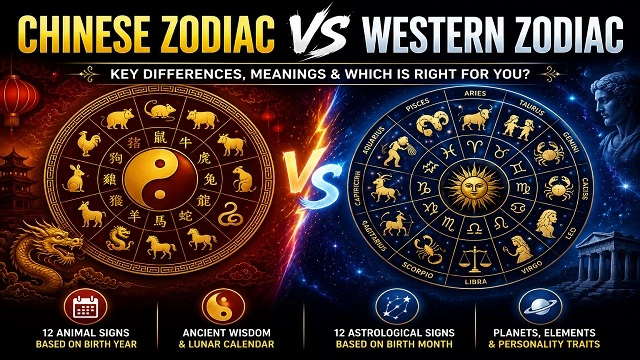
If you’ve ever compared your Western zodiac sign with your Chinese zodiac animal and wondered why they seem to be describing two completely different things, you’re not imagining it. These are two entirely separate systems, built on different calendars, different timeframes, and honestly, different philosophies about what the sky (or the year) is even supposed to tell you about a person.
A lot of people assume Chinese zodiac and Western zodiac are just cultural variations on the same basic idea — swap the animals for the constellations and you’re good. That’s not really accurate, and once you see how differently they’re actually built, it makes a lot more sense why your “sign” can feel like two totally different personality quizzes depending on which one you’re looking at.
Chinese Zodiac vs Western Zodiac: The Core Difference in Timeframe
The single biggest difference between Chinese zodiac and Western zodiac comes down to timing. Western astrology assigns your sign based on a roughly month-long window within a single year — your Sun sign is locked in by your birth month and day, and it’s the same every year regardless of which year you were born in. Someone born on July 10th is a Cancer whether that’s 1995 or 2010.
Chinese zodiac works on a completely different scale. Instead of a monthly window, it assigns your animal sign based on the entire year you were born in, following a 12-year cycle. So instead of twelve roughly month-long slots repeating every year, you get twelve full years, each one belonging to a different animal, that only cycle back around once every 12 years. Someone born in 1995 is a Pig; someone born the following year, 1996, is an entirely different animal, the Rat.
Chinese Zodiac vs Western Zodiac: How Each System Actually Determines Your Sign
This difference in timeframe comes from a deeper difference in what each system is actually tracking astronomically.
Western astrology is based on the Sun’s apparent position relative to the twelve constellations of the zodiac belt, as seen from Earth over the course of one year. As Earth orbits the Sun, the Sun appears to pass through each constellation for about a month at a time, which is why your sign is tied to your birth month.
Chinese zodiac isn’t based on the Sun’s position at all — it’s rooted in the traditional Chinese lunisolar calendar, a calendar system that tracks both the Moon’s phases and the solar year together. Your animal sign is simply assigned to the calendar year you were born in, based on a repeating 12-year cycle that Chinese tradition has followed for over two thousand years.
This is also why Chinese zodiac years don’t line up with January 1st. Because the calendar is lunisolar, the Chinese New Year shifts every year, usually landing somewhere between January 21st and February 20th. If you were born in January or early February, this actually matters — you might share a birth year with the Rat on the calendar, but if your birthday falls before that year’s Chinese New Year, your real zodiac animal is actually the one from the year before.
Chinese Zodiac vs Western Zodiac: Twelve Signs, But Built Very Differently
Both systems land on the number twelve, which is probably part of why people assume they’re more similar than they are. But look at what’s actually being divided into twelve, and the difference is obvious.
Western zodiac divides a single calendar year into twelve roughly equal chunks, one sign per chunk, repeating every year without fail. Chinese zodiac divides a 12-year span into twelve chunks, one animal per full year, and doesn’t repeat until the entire cycle comes back around 12 years later.
There’s also a layer Western zodiac doesn’t really have an equivalent for: Chinese zodiac combines its 12-animal cycle with a separate 5-element cycle — Wood, Fire, Earth, Metal, and Water — with each element spanning two consecutive years. Combine the 12-year animal cycle with the 5-element cycle, and you actually get a much longer 60-year cycle before the exact same animal-element combination repeats. So while there are only 12 possible Western sun signs, there are 60 distinct animal-element combinations in Chinese zodiac before you see the same one again.
Chinese Zodiac vs Western Zodiac: Different Traits, Different Traditions
Because the two systems are built on totally different foundations, the personality traits they describe don’t map onto each other in any clean way, and that’s expected — they’re not meant to.
Western zodiac traits are traditionally organized around elements (Fire, Earth, Air, Water) and modalities (Cardinal, Fixed, Mutable), giving each sign a specific combination that shapes its described temperament. A Fire sign like Aries is read as bold and quick to act; a Water sign like Cancer is read as intuitive and emotionally attuned.
Chinese zodiac traits are tied to the symbolic nature of each animal itself, shaped by centuries of Chinese folklore, storytelling, and cultural association. The Ox is associated with dependability and hard work. The Tiger is associated with courage and boldness. The Rabbit is associated with gentleness and diplomacy. These associations come from a totally different cultural and mythological well than the element-and-modality logic behind Western astrology.
Neither framework is “more correct” than the other — they’re just different lenses, developed independently by different cultures over different centuries, for thinking about personality and fate.
Chinese Zodiac vs Western Zodiac: Where They Came From
Western zodiac has roots in ancient Babylonian astronomy, later developed further by ancient Greek astrologers, who’re largely responsible for the version of the zodiac most commonly used in the West today. It’s tied closely to Greco-Roman mythology, which is where most of the sign names and symbols (the Ram, the Twins, the Scales) actually come from.
Chinese zodiac developed independently within Chinese culture, with roots that some historians trace back over two thousand years, tied to Chinese folklore, agricultural cycles, and traditional Chinese astronomy and calendar-keeping. It’s not a variation or offshoot of Western astrology — it grew up entirely separately, in a different part of the world, out of a different set of cultural stories and astronomical observations.
It’s worth mentioning that Chinese zodiac isn’t exclusive to China, either. Variations of the same 12-animal cycle are used across much of East and Southeast Asia, including Vietnam, Korea, and Japan, sometimes with small variations (Vietnam, for example, swaps the Rabbit for the Cat in its version of the cycle).
Can You Use Both Systems Together?
Plenty of people do, and there’s no real conflict in doing so, since the two systems aren’t making competing claims about the same thing — they’re describing completely different measurements. You can be a Western Leo and a Chinese Dragon at the same time; one describes where the Sun was during your birth month, the other describes which year, in a 12-year cycle, you happened to be born in. Some numerology and astrology enthusiasts even enjoy comparing the two, treating the combination as a fuller, more layered picture rather than something that needs to line up perfectly.
A Quick, Honest Note
Neither Chinese zodiac nor Western zodiac is a scientifically validated system for predicting personality or life outcomes. Both are long-standing cultural and symbolic traditions that plenty of people find meaningful and enjoyable to explore, but neither has research support behind its predictive claims. Treat either one — or both together — as a fun lens for reflection, not a factual account of who you are.
Find Your Signs in Both Systems
If you want to see where you land in each system:
- A Western zodiac calculator can tell you your Sun sign, element, and modality from just your birth date.
- A Chinese zodiac calculator, using real historical Chinese New Year dates rather than just the calendar year, can tell you your animal sign and element.
- If you’re curious how two people’s signs relate to each other, a Chinese zodiac compatibility calculator can check your animal signs against the traditional San He, Liu He, and Liu Chong relationship systems.
Frequently Asked Questions
Is Chinese zodiac more accurate than Western zodiac?
Neither system is more “accurate” than the other in a scientific sense — both are traditional, symbolic frameworks rather than empirically validated ones. They’re simply built on different astronomical and cultural foundations, tracking different things.
Can my Western sign and Chinese sign contradict each other?
Not really, since they’re not describing the same thing. Your Western sign reflects the Sun’s position during your birth month; your Chinese sign reflects which year, in a 12-year cycle, you were born in. There’s no expectation that they’d “agree.”
Why does my Chinese zodiac year seem off if I was born in January?
Because the Chinese calendar is lunisolar, Chinese New Year falls on a different date each year, usually between January 21st and February 20th. If your birthday falls before that year’s Chinese New Year, your zodiac animal actually belongs to the previous year.
Do other Asian countries use the same Chinese zodiac system?
Mostly yes, with small variations. Vietnam, Korea, and Japan all use versions of the same 12-year animal cycle, though Vietnam notably replaces the Rabbit with the Cat.
This article is intended for general informational and entertainment purposes. Both Chinese and Western zodiac systems are traditional, cultural belief frameworks, not empirically validated sciences, and shouldn’t be used as the basis for major life, financial, medical, or legal decisions.