Which Planet Is Responsible for Job Loss? Full Guide
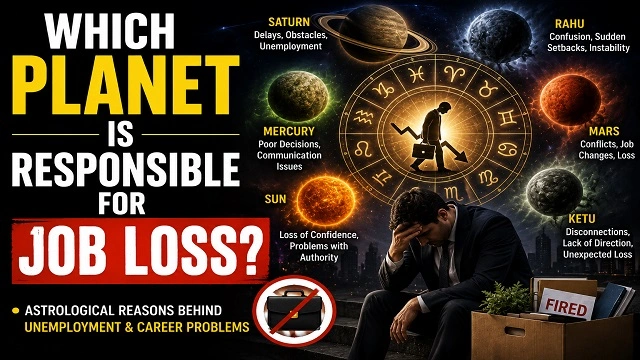
Losing a job rarely feels like a single event. It feels like a slow unraveling — a boss who suddenly goes cold, a company “restructuring” out of nowhere, a project that quietly dies on the vine until there’s nothing left for you to do. If you’ve been through it, or you can feel it coming, you’ve probably asked the same question a lot of people type into Google at 2 a.m.: which planet is responsible for job loss?
In Vedic and Western astrology alike, career instability is rarely blamed on one single planet acting alone. It’s usually a combination — a weak or afflicted planet in your career house, paired with a rough transit passing through at exactly the wrong time. But if you’re looking for the main culprit, most astrologers will point you in the same direction first.
Which Planet Is Responsible for Job Loss in Astrology?
Saturn is the planet most commonly linked to job loss, layoffs, and career setbacks. It’s not because Saturn is “evil” — far from it. Saturn is the planet of structure, discipline, and long-term consequences. When Saturn is weak, afflicted, or moving through a difficult transit in your chart, it has a habit of dismantling whatever isn’t built on solid ground. That includes jobs that were shaky to begin with, roles you’d outgrown, or work environments that were never really sustainable.
That said, Saturn rarely works alone. The Sun (which rules authority and ego clashes with bosses), Rahu (sudden, chaotic change), Ketu (detachment and abrupt endings), and an afflicted 10th house lord all play supporting roles. Think of Saturn as the planet holding the wrecking ball, and the others as the reasons it swings when it does.
Saturn: The Planet That Tests Your Career Foundations
Saturn moves slowly. It spends roughly two and a half years in each zodiac sign, and its transits are famous for being some of the longest and most tested periods in a person’s life. When Saturn is transiting your 10th house (career), your 2nd house (income), or your 6th house (daily work and service), job-related stress tends to spike.
This is the planet that asks uncomfortable questions. Are you actually good at this job, or have you been coasting? Is this company as stable as it looks? Have you been cutting corners somewhere? Saturn doesn’t punish people randomly — at least, that’s how traditional astrology frames it. It exposes what wasn’t solid in the first place.
People going through a Sade Sati (the seven-and-a-half-year Saturn transit over, before, and after your natal Moon sign) often report this exact pattern: a job that seemed fine suddenly starts falling apart, piece by piece, over months rather than all at once.
Why Saturn Transits Hit Your Career So Hard
A few reasons come up again and again when astrologers talk about Saturn and career loss:
- Saturn rules limitation. When it transits your 10th house, it can restrict opportunities, freeze promotions, or bring your workload to a grinding halt.
- Saturn rewards patience, not shortcuts. If a job was built on hype, favoritism, or a bubble that was never going to last, Saturn tends to be the planet that pops it.
- Saturn’s transits are slow, which makes them feel heavier. A quick planetary influence passes in days. A Saturn transit can shape two or three years of your working life.
It’s worth saying clearly: none of this means Saturn is “bad luck” in some simple sense. Plenty of people go through Saturn transits and come out with better jobs, better boundaries, and more self-respect than they walked in with. It’s a demanding teacher, not a punishment.
The Sun and Job Loss: When Authority Clashes Get Ugly
If Saturn sets the stage, the Sun often plays the role of the argument that finally ends things. The Sun represents ego, authority, government, and your relationship with people in power over you — your boss, essentially. A weak or afflicted Sun in your 10th house can show up as constant friction with management, feeling unseen or undervalued at work, or getting caught in office politics you didn’t start.
When the Sun is under stress during a transit — especially when it’s combined with a difficult Saturn placement — job loss often comes wrapped in some kind of conflict with authority. A falling-out with a manager. A company restructuring that “just happens” to eliminate your exact role. A promotion promised and never delivered.
Rahu, Ketu, and the Sudden Career Upheaval
Not every job loss builds slowly. Sometimes it’s a phone call on a random Tuesday afternoon. That’s Rahu and Ketu’s signature.
Rahu is associated with sudden, often unpredictable change — new technology replacing your role, an industry shift nobody saw coming, a merger that reshuffles the entire org chart overnight. Ketu, on the other hand, brings detachment. It shows up when you’ve quietly stopped caring about a job long before you consciously realized it, and the universe seems to notice before you do.
When Rahu or Ketu transits your 10th house or afflicts your 10th house lord, career changes tend to feel abrupt rather than gradual. One day you have a job. The next, you’re updating your resume.
Mars, Rahu, and Workplace Conflict
There’s one more pattern worth mentioning: Mars. Mars rules aggression, competition, and impulsiveness. An afflicted Mars in the 10th house, especially when paired with Rahu, can point toward job loss caused by conflict — arguments, impulsive decisions (yours or someone else’s), or a workplace environment that turns hostile before it turns empty.
If your job loss felt less like “the company changed direction” and more like “things got tense and then I was gone,” Mars is usually somewhere in that story.
How to Tell If a Planet Is Actually Behind Your Job Loss
Here’s where a lot of people go wrong: they read that Saturn causes job loss, notice Saturn is somewhere in their chart, and assume that’s the whole answer. Astrology doesn’t really work like a single ingredient. What matters is the combination:
- Which planet rules your 10th house (career), and how strong or weak is it?
- Is that planet — or the 10th house itself — currently being transited by Saturn, Rahu, or Ketu?
- Are there any afflictions (difficult aspects) between your career planets and planets tied to conflict, like Mars or Rahu?
- Does your Dasha period (in Vedic astrology) match up with a career-disrupting planet?
A single tough transit rarely causes real damage on its own. It’s usually the overlap — a weak natal placement plus a challenging transit plus a Dasha period that isn’t supporting you — that turns “a rough patch at work” into “I don’t have a job anymore.”
What You Can Do When These Transits Hit
If you suspect you’re in the middle of one of these periods, astrology traditionally suggests a few approaches, though none of them are substitutes for practical action:
- Build savings before the transit peaks, if you can see it coming. Saturn transits especially tend to be visible in advance if you know your chart.
- Avoid major risks during Saturn or Rahu-heavy periods. This isn’t the ideal window to bet everything on a shaky startup or burn bridges with a difficult boss.
- Use the period to build skills, not just endure it. Saturn rewards discipline. Ironically, the people who use a hard Saturn transit to upskill or requalify often land better roles once it passes.
- Don’t ignore the practical side. Update your resume, keep your network warm, and treat any warning signs at work seriously — astrology can point at timing, but it doesn’t replace paying attention to what’s actually happening around you.
A Few Honest Notes
It’s tempting to look at a job loss and want a single, clean explanation — one planet, one villain, one reason. Real charts are messier than that. Saturn tends to be the planet most associated with career setbacks, but the Sun, Mars, Rahu, and Ketu all show up as supporting characters depending on how your specific chart is built.
If you want a clearer, personalized read, the placement of your 10th house lord and whichever planet is currently transiting it matters more than any general rule. A qualified astrologer — or a detailed birth chart calculator — can help you see the specific combination playing out in your own chart, rather than relying on a one-size-fits-all answer.
Frequently Asked Questions
Is Saturn always responsible for job loss?
Not always, but it’s the planet most consistently linked to career setbacks, especially during transits over the 10th house or during Sade Sati. Other planets like Rahu, Ketu, and Mars often play a role too.
Can a good planet placement protect you from job loss during a Saturn transit?
A strong, well-placed 10th house lord can soften the impact significantly. Some people go through the same transit that devastates someone else’s career and barely notice it, largely because of how their natal chart is set up.
How long does a career-disrupting transit usually last?
Saturn transits through a single house typically last around two and a half years, though the most intense effects are usually concentrated in a shorter window within that period.
Does astrology mean I have no control over losing my job?
No. Astrology is generally treated as a map of timing and tendencies, not a fixed script. Practical steps — networking, upskilling, financial planning — matter just as much, if not more, during difficult transits.
This article is based on traditional astrological interpretations and is intended for entertainment and self-reflection purposes only. It is not a substitute for professional career, financial, or legal advice.



Pingback: Signs a Cancer Man Has Feelings for You - Career Birth Chart Calculator