How to Read Astrology Birth Chart: Step by Step
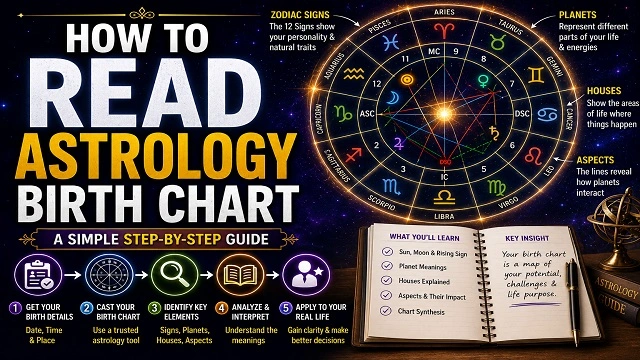
The first time you pull up your birth chart, it looks like a math problem designed by someone who really doesn’t like you. Circles inside circles, tiny glyphs that look vaguely like the alphabet had a stroke, numbers scattered everywhere, and lines crisscrossing the middle like someone’s been playing connect-the-dots with no plan. Most people close the tab within thirty seconds.
Here’s the good news: once you understand the four or five building blocks that make up a birth chart, the whole thing stops looking like a puzzle and starts looking more like a story about you. This guide walks through exactly how to read an astrology birth chart, piece by piece, without the jargon overload most sites throw at you on day one.
How to Read an Astrology Birth Chart: The Big Picture First
Before you zoom into individual symbols, it helps to know what you’re actually looking at. A birth chart — sometimes called a natal chart — is a snapshot of where every planet was sitting in the sky at the exact moment you were born, mapped against the backdrop of the twelve zodiac signs and divided into twelve houses.
Three things layer on top of each other to build the full picture:
- The planets — what kind of energy is being expressed (love, ambition, conflict, communication, and so on)
- The signs — how that energy tends to behave or show up
- The houses — where in your life that energy plays out
Once those three pieces click, the rest of the chart is just detail work.
Step One: Find Your Big Three
Almost every beginner’s guide to reading a birth chart starts here, and for good reason — your Sun, Moon, and Rising sign (also called your Ascendant) do most of the heavy lifting.
Your Sun sign is the one you already know — it’s your basic identity, ego, and the “main character energy” of your personality. It’s what most horoscope columns are actually talking about.
Your Moon sign governs your emotional inner world — how you process feelings, what makes you feel safe, and how you react when things go sideways. This one tends to surprise people the most, because it often feels more “you” than your Sun sign does.
Your Rising sign is the mask you wear when you first meet someone — your instinctive first reaction to the world, and often how other people describe you before they really know you.
If you only remember one thing from this section, remember this: your Sun sign is not your whole chart. It’s one-third of your “Big Three,” and honestly, one of dozens of placements that matter.
Step Two: Understand What the Planets Actually Mean
Once you’ve got your Big Three, the rest of the planets fill in the details. Here’s a quick cheat sheet for what each one represents:
- Mercury — communication, thinking style, how you learn and talk
- Venus — love, beauty, money, and what you find attractive or valuable
- Mars — drive, anger, ambition, and how you go after what you want
- Jupiter — luck, growth, expansion, and where life tends to be generous with you
- Saturn — discipline, limitation, responsibility, and the lessons that take the longest to learn
- Uranus — sudden change, rebellion, and where you break from convention
- Neptune — dreams, illusion, spirituality, and where reality gets a little blurry
- Pluto — transformation, power, and the parts of life that get completely rebuilt from the ground up
Each planet lands in one of the twelve zodiac signs in your chart, and that sign shapes how the planet’s energy comes out. Mars in fiery Aries, for example, tends to act on impulse. Mars in careful, earthy Capricorn is far more calculated about when it strikes.
Step Three: Learn What the Houses Represent
This is the part most beginner guides rush through, but it’s arguably the most useful piece once you’re trying to read your own chart instead of just memorizing sign meanings.
The birth chart is divided into twelve houses, and each one governs a different area of life:
- 1st House — self, identity, first impressions
- 2nd House — money, possessions, personal values
- 3rd House — communication, siblings, short trips, everyday learning
- 4th House — home, family, roots, your emotional foundation
- 5th House — romance, creativity, kids, self-expression
- 6th House — daily work, health, routines, service
- 7th House — partnerships, marriage, one-on-one relationships
- 8th House — intimacy, shared resources, transformation, taboo topics
- 9th House — travel, higher education, philosophy, beliefs
- 10th House — career, public reputation, life direction
- 11th House — friendships, community, hopes and goals 12th House — subconscious, isolation, hidden strengths and struggles
If Saturn sits in your 10th house, for instance, that’s a career story — likely one about discipline, slow progress, and long-term achievement rather than overnight success. The same Saturn placed in your 5th house tells a completely different story, this time about creativity or romance requiring more patience than usual.
Step Four: Read the Aspects (Without Losing Your Mind)
Aspects are the angles planets form with each other, and they’re usually shown as lines connecting different points inside the chart wheel. This is the part that scares people off the most, so here’s the simplified version.
- Conjunctions (planets sitting close together) blend two energies into one intense combo
- Trines and sextiles are the “easy” aspects — energy flows smoothly, sometimes almost too smoothly
- Squares and oppositions are the “growth through friction” aspects — tension that forces change, even if it doesn’t feel great in the moment
You don’t need to memorize every possible aspect combination to get value out of your chart. Even just noticing which planets are tightly connected to your Sun, Moon, or Rising will tell you a lot about your core tensions and natural talents.
Putting It All Together: A Simple Example
Say someone has Sun in Leo, Moon in Cancer, Rising in Virgo, with Mars in Scorpio sitting in their 8th house. Reading that in plain language: this is someone whose outer confidence (Sun in Leo) hides a genuinely sensitive, protective inner world (Moon in Cancer). They come across as careful and detail-oriented at first meeting (Virgo Rising), but underneath, there’s an intense, private drive (Mars in Scorpio) tied to deep transformation, trust, or shared resources (8th House).
That’s the whole method in miniature: layer sign plus planet plus house, then notice how they interact. No memorized textbook definitions required — just pattern recognition once you know what each piece is asking.
Common Mistakes Beginners Make Reading Their Own Chart
A few habits trip up almost everyone in the first few months of learning this:
- Treating the Sun sign as the whole personality. It’s one placement among many — ignore the rest and you’ll misread yourself constantly.
- Skipping the houses entirely. Signs and planets tell you what and how; houses tell you where. Without houses, you’re missing half the story.
- Getting overwhelmed by every single aspect at once. Start with aspects to your Big Three. Expand from there once it feels manageable.
- Forgetting that birth time matters. Your houses and Rising sign shift throughout the day, so an exact birth time (not just the date) makes a real difference in accuracy.
Why Your Birth Time Matters More Than You’d Think
If you’ve ever compared your chart using two slightly different birth times and gotten wildly different results, this is why. The houses rotate roughly every two hours, meaning even a thirty-minute difference in birth time can shift your Rising sign and rearrange which house each planet lands in. If you’re serious about reading your chart accurately, it’s worth digging up your birth certificate or asking family members for the exact time, rather than guessing.
Final Thoughts on Reading Your Own Chart
Learning how to read an astrology birth chart isn’t about memorizing a dictionary of symbols overnight. It’s closer to learning a new language — a little clunky and slow at first, then suddenly you’re reading full sentences without translating word by word in your head. Start with your Big Three, layer in the houses, notice the aspects that keep showing up around your Sun, Moon, and Rising, and the rest tends to fall into place with practice.
Frequently Asked Questions
Do I need my exact birth time to read my chart?
It helps a lot. Your Sun sign doesn’t depend on birth time, but your Rising sign and house placements do, and those shift the entire interpretation of your chart.
What’s the easiest part of a birth chart to start with?
Your Big Three — Sun, Moon, and Rising. They give you a solid, workable snapshot before you dive into the more detailed layers like aspects and minor planets.
Can two people born on the same day have different charts?
Yes, if they’re born in different cities or at noticeably different times. Location and birth time both shift the houses and Rising sign, even when the Sun sign stays the same.
Is a birth chart the same as a horoscope?
Not quite. A horoscope usually only looks at your Sun sign in a general way. A birth chart is a full, personalized map built from your exact birth date, time, and location.
This article is intended for entertainment and self-reflection purposes only and is not a substitute for professional guidance of any kind.